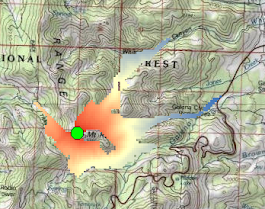
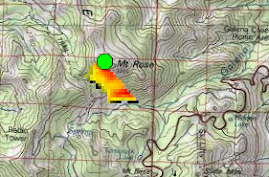
Least-cost paths have received widespread use in fields that
aim to understand how people, animals, and particles might move across
landscapes. In ecology least-cost paths have been used to examine connectivity
of individuals, propagules, and genes, as well as serve as the basis for many
corridor-building applications for the purpose of conserving habitat.
Adriaensen et al. (2003) introduced the
concept into ecology as an alternative to Euclidean distance and provided
examples from the Belgian landscape. Using a heterogeneous raster-based
landscape in which digital maps (rasters) are assigned cost distances (also
known as resistance) the least-cost path uses Dijkstra’s algorithm to identify
the shortest path in terms of cumulative cost/resistance. The algorithm
identifies a single least-cost path that is one cell wide. In an ecological context this assumes that
the animal/propagule has sufficient knowledge of the landscape to identify and
follow that “best” path. Pinto and Keitt (2009) identified that in many cases
organisms don’t have perfect knowledge of their environment and that multiple
realizations of the shortest path may be necessary to account for variability
in movement. Their approach was to develop stochastic, rather than static,
realizations of the least-cost path, which they implemented in Java software
LORACS (no longer available) (Pinto et al. 2012).
McRae et al.
(2007) introduced the idea of using circuit theory is used to model dispersal
behavior. Unlike a single least-cost
path circuit theory models the dispersal of many organisms/electrons resulting
in multiple paths across the landscape. Movement is based on random walk theory
and is proportional to the resistance/cost surface. Circuit theory, unlike a
least-cost path, doesn’t assume that an organism would have perfect knowledge
of its landscape. Circuit theory has received widespread use in ecology (Dickson
et al. 2019) and has been used to understand gene flow across landscapes, model
animal movements, and develop conservation corridors. However, outputs from
circuit theory provide the user with little control and can sometimes be
difficult to translate into corridors.
The randomized
shortest-path was introduced by Saerens et al. (2009) and has been implemented
in the R package gdistance (Van Etten 2020). The randomized shortest-path
approach bears many similarities to the multiple shortest paths approach of
Pinto and Keitt (2009), of which the ability to control the level of
randomization is among the most important features. In the gdistance package
this is done by controlling the theta parameter. The Multiple Shortest Paths
Toolbox for ArcMap is built on these ideas while providing similar
functionality in an ArcGIS environment.
You can download the toolbox by clicking HERE.
Adriaensen, F., Chardon, J. P., De
Blust, G., Swinnen, E., Villalba, S., Gulinck, H., & Matthysen, E. (2003).
The application of ‘least-cost’modelling as a functional landscape model. Landscape
and Urban Planning, 64(4), 233-247.
Dickson, B. G., Albano, C. M., Anantharaman, R., Beier, P.,
Fargione, J., Graves, T. A., ... & Theobald, D. M. (2019). Circuit‐theory
applications to connectivity science and conservation. Conservation Biology,
33(2), 239-249.
McRae, B. H., & Beier, P. (2007).
Circuit theory predicts gene flow in plant and animal populations. Proceedings
of the National Academy of Sciences, 104(50), 19885-19890.
Pinto, N., & Keitt, T. H. (2009).
Beyond the least-cost path: evaluating corridor redundancy using a
graph-theoretic approach. Landscape Ecology, 24(2), 253-266.
Pinto, N., Keitt, T. H., &
Wainright, M. (2012). LORACS: JAVA software for modeling landscape connectivity
and matrix permeability. Ecography, 35(5), 388-392.
Saerens, M., Achbany, Y., Fouss, F.,
& Yen, L. (2009). Randomized shortest-path problems: Two related models. Neural
Computation, 21(8), 2363-2404.
Van Etten, J.M. (2020). Package
‘gdistance’. R package version 1.1-2.